How Does Smart Voice Work?
From spoken thoughts to considered words.
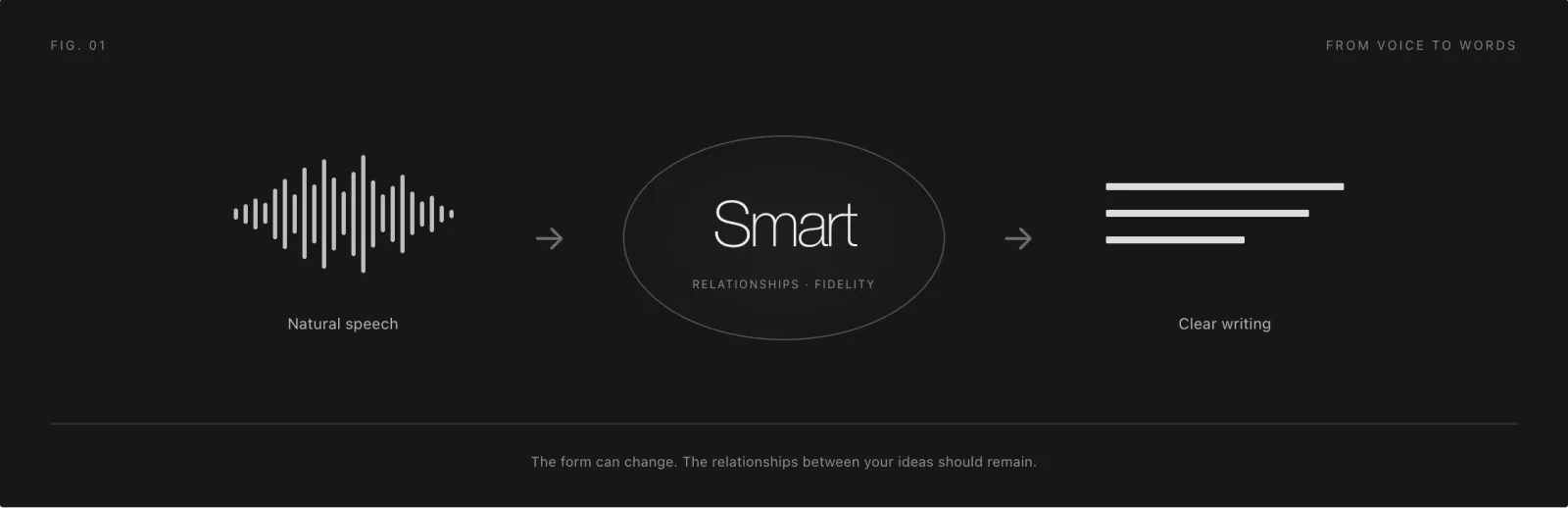
The form can change. The relationships between your ideas should remain.
Good editing starts with what must stay.
A spoken sentence can contain the message, a hesitation, a revision, and an explanation at once. A transcript can capture all of them without resolving which detail is final, which part explains why, and which sound is simply a pause.
Smart approaches this as editing constrained by fidelity: improving local grammar and readability while preserving facts, reasons, conditions, negation, and uncertainty. The words become easier to read while the judgment remains yours.
Clearer expression. Still unmistakably you.
“Maybe” should still mean maybe. “I think” should still signal your perspective. Meaningful emphasis, contrast, and additions deserve to stay. The context supplies the evidence for each edit.
Complexity in the system. Clarity in your words.
After speech recognition, Smart’s independent polishing path performs semantic editing in one logical model call, followed by explicit formatting rules in code. A logical call is not a promise of one physical request: retries or failover may still occur when services fail.
- Capture speech — Automatic speech recognition (ASR) converts audio into the transcript that anchors the editing process.
- Interpret the edit — A language model uses context to distinguish hesitations, explicit corrections, supplied spellings, and structural cues.
- Validate and normalize — The response is checked against its protocol, then deterministic formatting handles details such as script forms, number spacing, and closing punctuation.
- Return the text — The edited text returns to the input flow. You can revise it further and decide how to use it.
DESIGN BOUNDARY Ordinary Smart dictation works with the content you supply, without adding web search or tool execution. Dictating “send him a message…” produces text; it does not send a message. Translation requirements enter the processing flow when a target language is explicitly selected.
Keep the new date. Keep the reason, too.
Resolving a correction requires identifying an explicit replacement within the same event. Updating a time does not change the location. Withdrawing an arrangement does not make its explanation irrelevant.
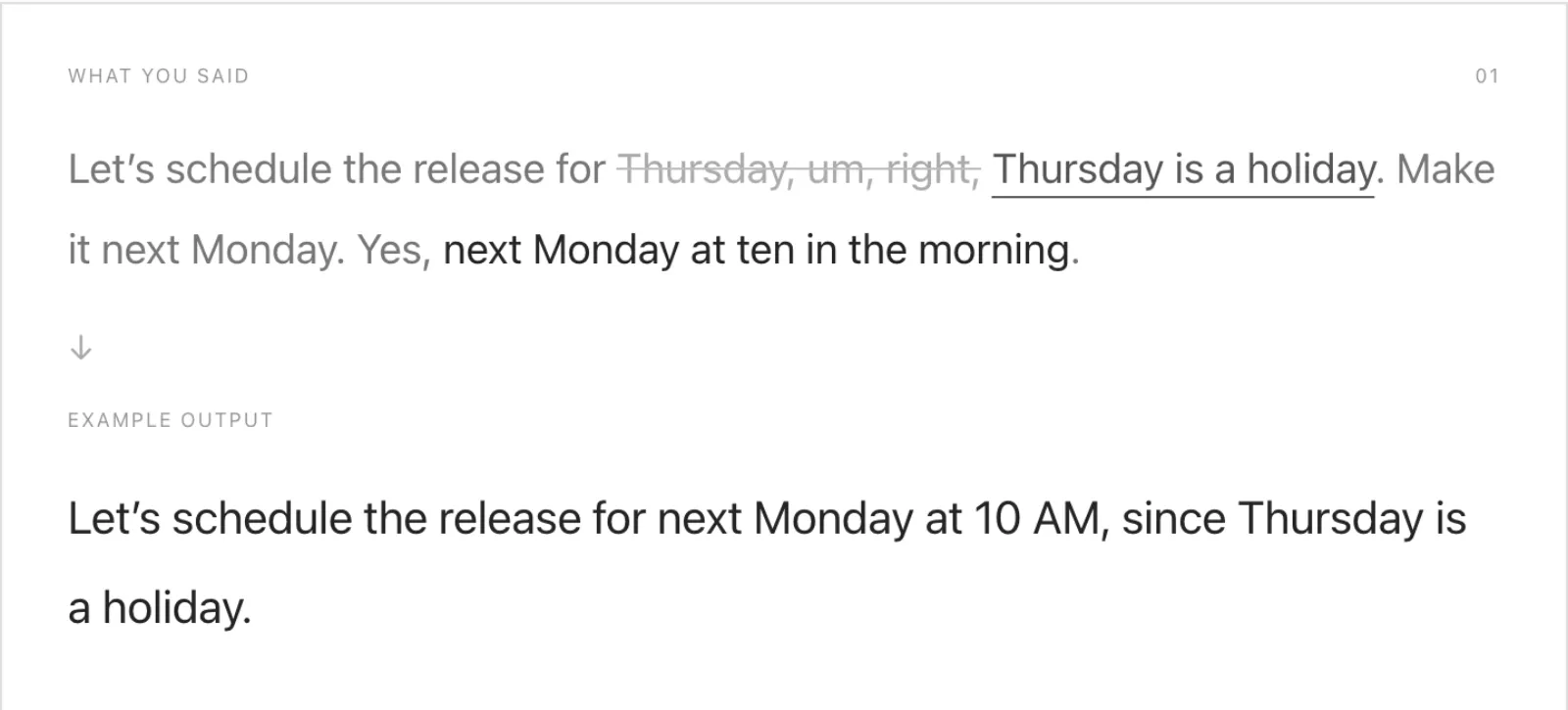
- Final arrangement — “Next Monday at ten” replaces the withdrawn time for the same event.
- Independent reason — “Thursday is a holiday” explains the change and should survive removal of the old plan.
- Empty hesitation — Empty word-search sounds and redundant confirmation can be removed so the final intent reads clearly.
This is an illustrative example. Actual wording may vary.
Intelligence shows up in the right small edits.
Clear the noise, keep the nuance
Distinguish empty pauses from meaningful responses, emphasis, and connections. Repair local grammar while keeping your stance.
Let the structure follow the thought
Use clear enumerations to form lists, organize longer speech by complete thoughts, and attach details to the point they explain.
Respect the spelling you supply
Explicit letters and capitalization guide names and identifiers. Familiarity alone is not evidence for replacing an unfamiliar name.
Turn formatting cues into formatting
Clear instructions for the current draft—new paragraphs, parentheses, and punctuation—become actual formatting.
These capabilities share one goal: preserve the substance. Fluent grammar is not proof of accuracy, and tidy structure is not proof that nothing was lost. Smart can still misread complex corrections, unfamiliar names, or layered structure. Give important numbers, dates, and names a final check before sending.
Clarity for your words. Clarity about your data.
Acti’s published privacy policy sets specific boundaries for voice data.
Cloud processing, defined retention
Ordinary dictation audio and related app context are discarded after the result returns. Transcripts and dictation history stay on your device.
Dictation is not training data
Acti does not train its own models on ordinary dictation. Model-provider terms prohibit using your content to train general-purpose models.
Separate consent for shared samples
Optional feedback samples require separate consent, with purpose, retention, and withdrawal explained. Text reused in other features follows those features’ rules.
Updated Oct 2, 2026 · Sections 2.9 & 5
This is a summary. See the policy for its full scope and exceptions.
Your next thought. Just say it.
Explore these everyday communication scenarios and see how Smart turns spoken thoughts into clear text.